
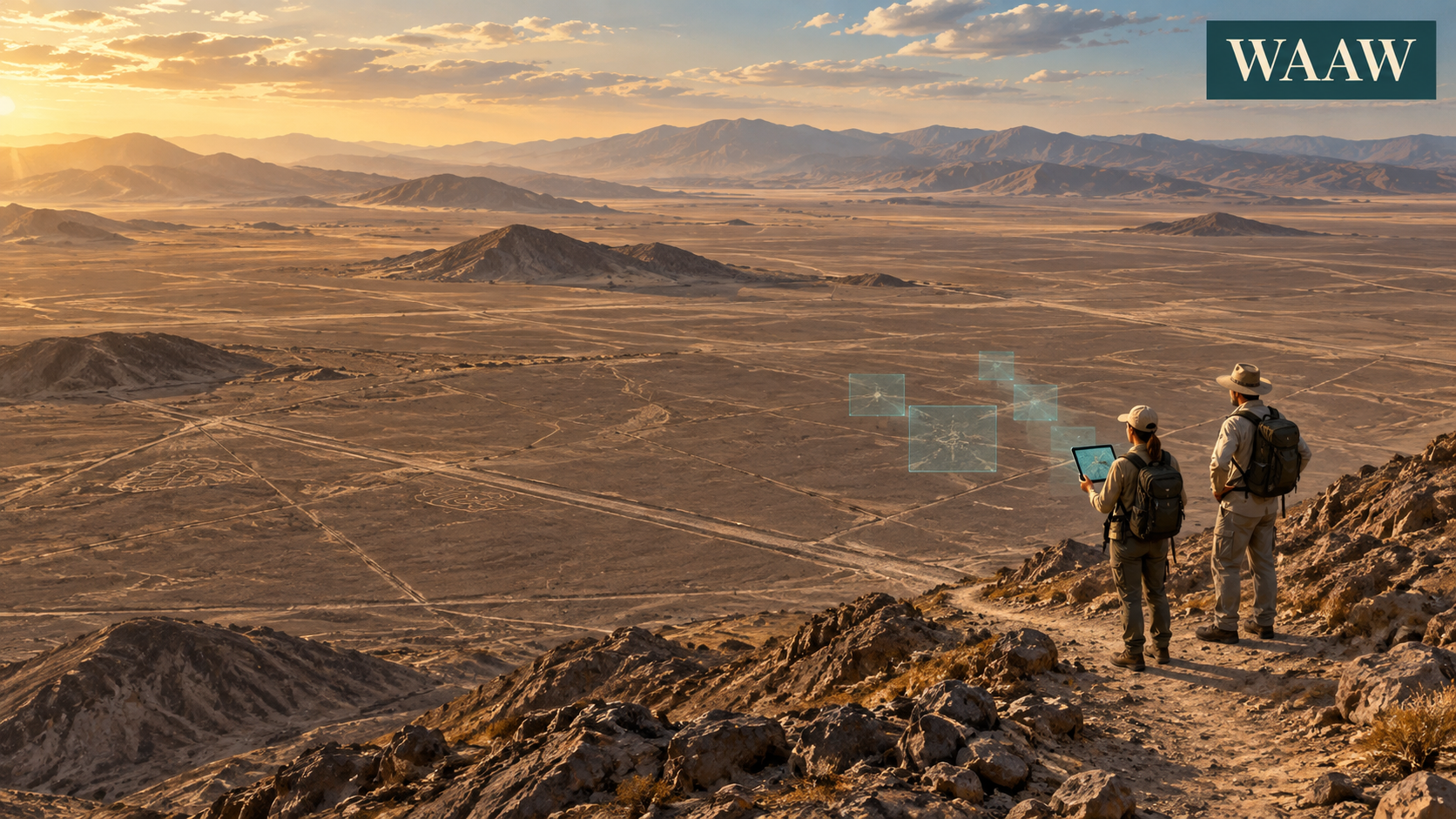
A faint mark in a desert photograph can be easy to overlook. Deciding that it deserves a closer look is one problem. Establishing what is actually there is another.
At Nazca in Peru, researchers from Yamagata University and IBM Research bring those two tasks together. Their AI-assisted survey documents 303 new figurative geoglyphs, drawings formed on the ground. The result appears in a September 2024 paper in PNAS, drawing on fieldwork from September 2022 through February 2023. This is an established research case, with a particularly revealing account of how discovery happens.

A better place to look
The university describes the practical obstacle: an enormous area to examine and small figures that are difficult to distinguish. AI analyzes aerial imagery to suggest places worth investigating. Archaeologists assess those suggestions and direct the field survey. [2]
That arrangement interests me because the output has a destination. A promising mark becomes a place someone can visit. The value of the software depends on what happens when the team reaches it.

Humanoid motif. Actual drone photograph from Figure 2, top row, first panel. White outlines are added by the researchers to guide the eye; the scale bar represents 5 metres. Credit: Sakai et al., PNAS (2024), © the authors, CC BY-NC-ND 4.0. Source. Complete individual panel extracted from the published figure.
The discovery count includes the people
Of the 303 figures, 178 receive individual AI suggestions. Another 66 belong to groups that AI helps locate. The remaining 59 come from fieldwork or screening outside the suggested boxes. Screening and fieldwork together require 2,640 human labor hours. [1]
Those distinctions are the heart of the story. They let us see a collaboration with several routes to a result. Sometimes the system directs attention to a figure. Sometimes that lead brings researchers to a group with more to discover. People also make discoveries beyond its suggestions.
I would want any evaluation of a discovery tool to preserve that accounting. It tells us where assistance helps, where human attention adds something, and why the final count belongs to the whole investigation.

Camelid motif. Actual drone photograph from Figure 2, middle row, third panel. Researchers’ white outline; 5-metre scale bar. Credit: Sakai et al., PNAS (2024), © the authors, CC BY-NC-ND 4.0. Source. Complete individual panel extracted from the published figure.
Look at the photograph, then the outline
The four discovery images here are actual research photographs. Their white outlines are interpretive guides supplied by the researchers. They are not bright lines painted across the desert. [1]
That distinction is useful when looking at the pictures. Let your eye follow an outline, then look at the texture beneath it. Consider how confidently you could recognize the same figure without that guide, among many other patches of ground.
For me, the images make the search problem much more tangible than a claim about processing speed. They also make a good companion to the conceptual cover: the cover introduces the idea, while these photographs let readers inspect the documented discoveries.

Killer-whale motif. Actual drone photograph from Figure 2, middle row, fifth panel. Researchers’ white outline; 5-metre scale bar. Credit: Sakai et al., PNAS (2024), © the authors, CC BY-NC-ND 4.0. Source. Complete individual panel extracted from the published figure.
Discovery opens the next question
Finding a figure and explaining its purpose remain different tasks. The paper offers interpretations of how different geoglyph types relate to trails and ceremonial activity. Those interpretations remain hypotheses.
Yamagata University also connects the research to heritage protection, including identifying figures potentially exposed to flooding and working with Peru’s Ministry of Culture. These are proposed applications of the work, rather than a measured preservation outcome.
I like that broader purpose. A fuller record can give people more to study and more to consider protecting. To judge whether the technology helps over time, I would want to follow that next stage as closely as the discovery announcement.

Bird motif. Actual drone photograph from Figure 2, bottom row, first panel. Researchers’ white outline; 5-metre scale bar. Credit: Sakai et al., PNAS (2024), © the authors, CC BY-NC-ND 4.0. Source. Complete individual panel extracted from the published figure.
What makes this a Where AI Actually Works story is the traceable journey from a suggestion to an investigation. The result comes with photographs, fieldwork, and an account of the people who do the checking. That is a satisfying kind of progress to examine: a tool helps direct attention, and human curiosity carries the work further.
Subscribe to Where AI Actually Works for one carefully researched story each week about humans and AI solving real problems.
This article was researched and written in partnership with AI. Every load-bearing figure traced back to the primary source and verified by a human before publication. The judgment about what to include, and what to leave out, is my own. Writing a series about humans and machines working together, it would be a little strange to pretend otherwise.
Sources for this bonus issue of Where AI Actually Works:
- Sakai and colleagues, PNAS, September 23, 2024. Primary research, methods, discovery accounting, and Figure 2 photographs.
https://doi.org/10.1073/pnas.2407652121 - Full paper hosted by the German Aerospace Center’s research repository:
https://elib.dlr.de/206765/1/sakai-et-al-2024-ai-accelerated-nazca-survey-nearly-doubles-the-number-of-known-figurative-geoglyphs-and-sheds-light-on.pdf - Yamagata University, September 24, 2024. Research summary and proposed next steps.
https://www.yamagata-u.ac.jp/en/information/info/20240924/
These sources describe the same project. The repository PDF is another copy of the primary paper, not a separate study. Discovery photographs: © the authors, CC BY-NC-ND 4.0. White outlines are supplied by the researchers.
https://creativecommons.org/licenses/by-nc-nd/4.0/
Leave a Reply